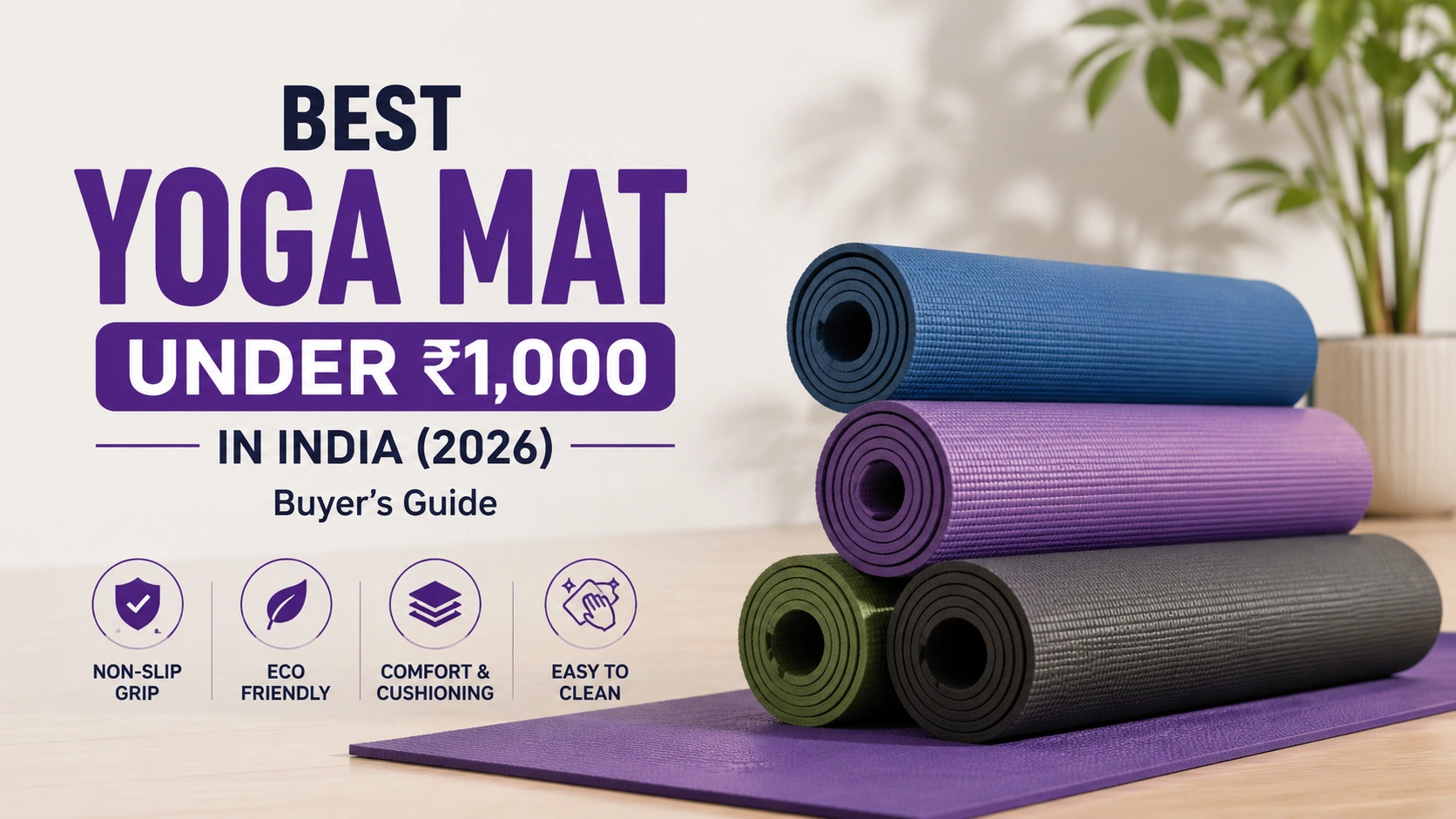
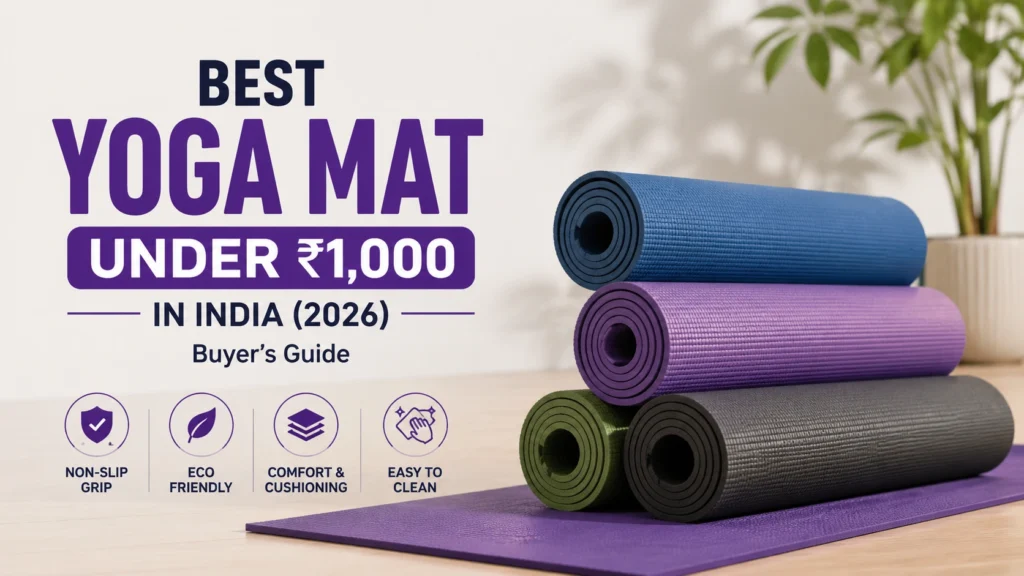
Millions of Indians are rolling out their mats for the first time in living rooms, on terraces, and in bedroom corners. But walk into any store or scroll through any marketplace, and you'll hit the same wall: mats priced at ₹2,000, ₹3,000, even ₹5,000. The assumption seems to be that a good yoga mat has to be expensive, but there are few options that you can get in this range as well.
There are genuinely solid yoga mats available under ₹1,000 in India, mats that grip Indian marble floors, handle monsoon-season sweat, and hold up to daily practice. You just need to know what to look for, and what to skip. We've tested the options and done the comparison. In this guide you will get the right choice for yoga mats under 10 minutes.
What to Look for in a Yoga Mat Under ₹1,000
Before diving into specific picks, here are the five factors that actually matter at this price range.
1. Thickness
For most beginners, 6mm is the sweet spot. It gives enough cushioning for your knees and wrists during floor poses without making balance work unstable. If you're doing more dynamic styles like Vinyasa, a 4mm mat gives better ground connection. If your knees or hips are sensitive, consider 8mm. Some options in this budget do go that thick. See our home gym setup guide for how mat thickness fits into a broader home practice space.
2. Material
At this price point, you're mostly choosing between three materials. PVC is the cheapest and widely available but can become slippery when wet and raises environmental concerns. NBR (Nitrile Butadiene Rubber) foam is softer and thicker, making it comfortable for floor-based work. It's the most common budget-friendly cushioning material. TPE (Thermoplastic Elastomer) is lighter, more eco-friendly, and performs better in humid conditions. If you can find a TPE mat under ₹1,000, it's generally worth the small premium over PVC.
3. Non-Slip Grip
This matters more in India than in most other markets. Marble and ceramic tile floors (the default in most Indian apartments) become genuinely slippery when your hands and feet are sweating. Look specifically for dual-sided anti-slip texture: a non-slip bottom layer that grips the floor and a textured top surface that holds your hands and feet. Single-sided or smooth-bottom mats are a real safety risk on polished stone.
4. Size
Standard mats run 173cm x 61cm. Extended mats go up to 183cm x 61cm, which makes a noticeable difference if you're taller than 5'8" or just prefer more room during floor sequences. Most budget mats in India come in standard size, if you need the extra length, it's worth checking the product dimensions before ordering.
5. Ease of Cleaning
For daily home practice, a mat you can't quickly wipe down becomes a hygiene problem fast. NBR foam and TPE mats clean easily with a damp cloth and mild soap. Avoid mats with deep textured ridges that trap sweat and are difficult to dry, especially important given India's humidity levels through much of the year.
Best Yoga Mats Under ₹1,000 in India - Our Top Picks
1. WiseLife Classic Eco-TPE Yoga Mat (8mm)
The WiseLife Classic is one of the few genuinely eco-friendly options you'll find in this price bracket. Made from TPE, it's tear-resistant, free from chemical odour, and much lighter than NBR foam mats of the same thickness. The 8mm cushioning is generous, your knees and wrists will thank you during longer floor sequences or restorative holds. It comes with a carry strap, which budget mats often skip.
- Key Specs: 8mm thickness | TPE material | 183cm x 61cm | Carry strap included
- Best for: Daily home practice, beginners who prioritise joint comfort
- One limitation: At the higher end of this budget (around ₹930), you may need a coupon code to bring it under ₹1,000 reliably.
- Our verdict: The best material choice in this price range if you can catch it at the right price.
2. Ahaniya Blue Yoga Mat
If you want a solid, reliable mat that holds up to regular Indian home practice without any fuss, this is the one to consider. The Ahaniya blue yoga mat is built with the practical realities of Indian floors in mind. It features dual anti-slip surfaces for both marble and rough tile, and dimensions that suit standard home practice spaces. It's the kind of mat that does its job without demanding attention.
- Key Specs: 6mm thickness | Anti-slip dual surface | Standard dimensions
- Best for: Regular home practice, beginners building a daily routine
- One limitation: If you primarily practice hot yoga or need maximum grip in very sweaty conditions, pairing with a yoga towel is advisable.
- Our verdict: A dependable everyday mat from an Indian brand that understands local conditions.
3. Boldfit Pro Yoga Mat (6mm Anti-Slip)
Boldfit has become a recognisable name in Indian fitness gear, and the Pro Yoga Mat earns that recognition. The NBR foam construction delivers solid cushioning, and crucially for Indian homes, it features anti-slip texture on both sides. The 6mm thickness is a practical middle ground for most types of yoga. It comes with a carry strap, and Boldfit offers a 1-year brand warranty, which is genuinely above average at this price point.
- Key Specs: 6mm thickness | NBR foam | 183cm x 61cm | Dual anti-slip | Carry strap
- Best for: Beginners and intermediate practitioners, anyone on marble or tile floors
- One limitation: NBR foam absorbs sweat over time, wipe it down after every session and allow it to fully air-dry before rolling up.
- Our verdict: The most widely available reliable mat at this price; the warranty gives added peace of mind.
4. Cosco Yoga Mat (6mm Anti-Skid)
Cosco is one of India's longest-standing sports equipment brands, and that heritage shows in this mat's build quality. The NBR foam provides slightly better cushioning than EVA at the same thickness, and the dual-textured surface grips from both sides. The included carry strap and 6-month warranty add genuine value. Cosco's widespread retail presence also means easier returns and replacements in tier-2 cities, a practical advantage that online-only brands can't match.
- Key Specs: 6mm thickness | NBR foam | 173cm x 61cm | Dual-textured surface | Carry strap
- Best for: Beginners doing knee-heavy poses, those who want retail return options
- One limitation: NBR foam has a noticeable initial smell, air it out for a day or two before first use.
- Our verdict: The smart pick if you're in a city with Decathlon access or want reliable warranty support.
5. Cult sport Yoga Mat (5mm)
The Cult.sport mat is the leanest option on this list - 5mm EVA foam that gives you a clean balance between portability and stability. It's lighter than NBR alternatives and easy to carry to a park or terrace. For standing and balancing poses, the firmer base actually works in its favour. If you're working through beginner sequences from our resistance band workout for beginners guide alongside your yoga practice, the lighter mat travels well between spaces.
- Key Specs: 5mm thickness | EVA foam | Anti-skid surface
- Best for: Beginners focused on standing poses, those who practice outdoors
- One limitation: Not enough cushioning for extended floor-based or restorative practice, knees will feel the hard surface.
- Our verdict: Good entry-level choice if joint sensitivity is not a concern.
Yoga Mat Comparison Table
|
Mat Name
|
Thickness
|
Material
|
Best For
|
Price Range
|
|
WiseLife Classic Eco-TPE
|
8mm
|
TPE
|
Joint comfort, eco-conscious practitioners
|
~₹930
|
|
Ahaniya Blue Yoga Mat
|
6mm
|
Anti-slip surface
|
Daily home practice, beginners
|
Under ₹1,000
|
|
Boldfit Pro Yoga Mat
|
6mm
|
NBR Foam
|
Marble/tile floors, all-round beginners
|
~₹700–799
|
|
Cosco Anti-Skid Yoga Mat
|
6mm
|
NBR Foam
|
Knee-heavy practice, retail returns
|
~₹600–750
|
|
Cult.sport Yoga Mat
|
5mm
|
EVA Foam
|
Outdoor practice, standing poses
|
~₹450–600
|
Which Yoga Mat Should You Buy?
Not sure which of these is right for you? Here are three quick scenarios.
- You're a complete beginner just starting out at home: Go with the Boldfit Pro or the Ahaniya blue yoga mat. Both give you the 6mm cushioning that makes learning foundational poses comfortable, dual anti-slip performance for Indian floors, and enough durability to grow with your practice. You don't need to overthink it at this stage.
- You practice daily and want something that holds up long-term: The WiseLife Classic TPE is the durability and materials winner in this range. TPE outlasts NBR foam under consistent daily use, doesn't absorb odour as readily, and is lighter to handle every day. It's worth waiting for a sale to bring it under ₹1,000.
- You want to practice on a terrace, balcony, or in a park: The Cult.sport 5mm EVA mat is your answer. It's the lightest option here, rolls up small, and handles the varied surfaces you'll encounter outdoors. If you're building a full home setup, our guide to home gym equipment for beginners covers what else pairs well with a basic yoga practice.
How to Take Care of Your Yoga Mat
A budget mat treated well will last 12 to 24 months of regular practice. A neglected budget mat will start peeling within three months. The difference comes down to a few simple habits.
Wipe the mat down after every sweaty session using a damp cloth and a few drops of mild liquid soap or a diluted vinegar solution. Avoid harsh cleaning sprays or bleach. They strip the surface texture and reduce grip permanently. After cleaning, hang the mat or lay it flat to air-dry completely before rolling it up. Rolling a damp mat encourages bacteria and breaks down foam from the inside.
For storage, roll the mat rather than fold it. Folding creates permanent creases that weaken the material and eventually cause it to crack along fold lines. Store it away from direct sunlight. UV exposure degrades both PVC and NBR foam faster than any amount of regular use.
Most NBR foam mats will show compression marks and reduced grip after 12 to 18 months of daily practice. At that point, it's worth upgrading rather than continuing on a mat that no longer grips reliably. Browse the full yoga mats and essentials collection when you're ready to step up.
Conclusion
You don't need to spend ₹2,000 or more to start a solid yoga practice. The mats above, particularly the Boldfit Pro for its dual anti-slip reliability on Indian floors and the WiseLife Classic TPE for its material quality and durability, demonstrate that the under ₹1,000 range has genuinely capable options.
For the all-round safest bet for a beginner on Indian marble or tile floors, the Ahaniya blue yoga mat and the Boldfit Pro are the two strongest starting points. Both handle the conditions that matter most for home practice in India.
Your mat is just the beginning. Once the practice takes hold, you'll want resistance bands, blocks, and other pieces that make home workouts more effective and more consistent. Browse Ahaniya's fitness essentials for home to build out your setup at the right pace and the right price.
Frequently Asked Questions
1. Is a ₹500 yoga mat worth buying in India?
At ₹500 and below, you're almost always getting a basic PVC or thin EVA foam mat. These work for light, occasional stretching and meditation, but for regular yoga practice with standing and floor poses on Indian marble, they tend to be too slippery when wet and too thin to protect your knees. If your budget is tight, spending an extra ₹100 to ₹200 to reach the ₹600 to ₹700 range gets you into NBR foam territory with proper dual anti-slip surfaces, and that difference matters for safety and longevity.
2. What thickness is best for yoga beginners?
6mm is the recommended starting point for most beginners. It provides enough cushioning to protect knees and wrists during learning, while remaining stable enough for standing poses and basic balances. If you have pre-existing knee, hip, or wrist sensitivity, an 8mm option is worth the consideration.
3. Can I use a yoga mat for floor exercises too?
Yes, and this is actually a good reason to invest in a slightly thicker mat. A 6mm or 8mm NBR foam mat works well for core exercises, stretching routines, bodyweight workouts, and Pilates alongside yoga. It doubles the utility of the mat and makes the purchase better value overall.
4. Which is better - PVC or TPE yoga mat?
TPE is better in almost every practical dimension for Indian conditions: lighter weight, better performance in humidity, no chemical odour, and more eco-friendly. The only real advantage of PVC is lower cost and sometimes firmer grip on dry surfaces. If you can find a TPE mat at a similar price to PVC options, and increasingly you can in the under ₹1,000 range, TPE is the smarter buy.
5. How do I clean a yoga mat at home?
Mix a small amount of mild liquid soap or white vinegar with water in a spray bottle. Lightly mist the mat surface, wipe down with a clean damp cloth, and then wipe again with a dry cloth to remove excess moisture. Hang or lay flat to air-dry fully before rolling up. Do this after every sweaty session and do a more thorough clean once a week for daily practitioners.