Most people setting up a home gym in India think about the big things first, a treadmill, a set of dumbbells, maybe a bench. Resistance bands almost always come last, which is honestly a mistake. A good set of resistance bands gives you a complete full body workout in your bedroom or living room corner without taking up any space and without costing anywhere near what other equipment does.
They work for building strength, warming up, shoulder and hip mobility, and even injury recovery, all from one small set. The problem is that searching online gives you hundreds of options with very little honest guidance. In this guide, you will know about the best resistance bands for home workouts in India, what each type does, how to pick the right one, and which exercises you can do at home without any other equipment.
What Are Resistance Bands and Why Are They Worth Using at Home
A resistance band is a stretchy band, usually made of latex or fabric, that creates tension when you pull or stretch it. Your muscles have to work against that tension, and that is what makes them stronger over time.
Think of it this way. When you do a squat with just your bodyweight, your legs are doing a set amount of work. Now loop a resistance band above your knees and do the same squat. Your glutes and outer thighs suddenly have to work much harder to keep your knees from caving in. Same exercise, but now you are getting significantly more out of it.
That is the basic idea behind resistance band training. They add load to exercises without requiring heavy equipment. They are also great for warming up before a workout, for shoulder and hip mobility work, and for rehabilitation exercises after an injury.
For anyone building a home gym in India where space is limited and budgets are tight, resistance bands are one of the smartest first purchases you can make. You can check our guide on home gym equipment for beginners to understand how bands fit into a complete home setup.
Types of Resistance Bands: Which One Is Right for You
Not all resistance bands are the same. Before buying, it helps to know the different types and what each one is designed for.
1. Loop Bands or Mini Bands
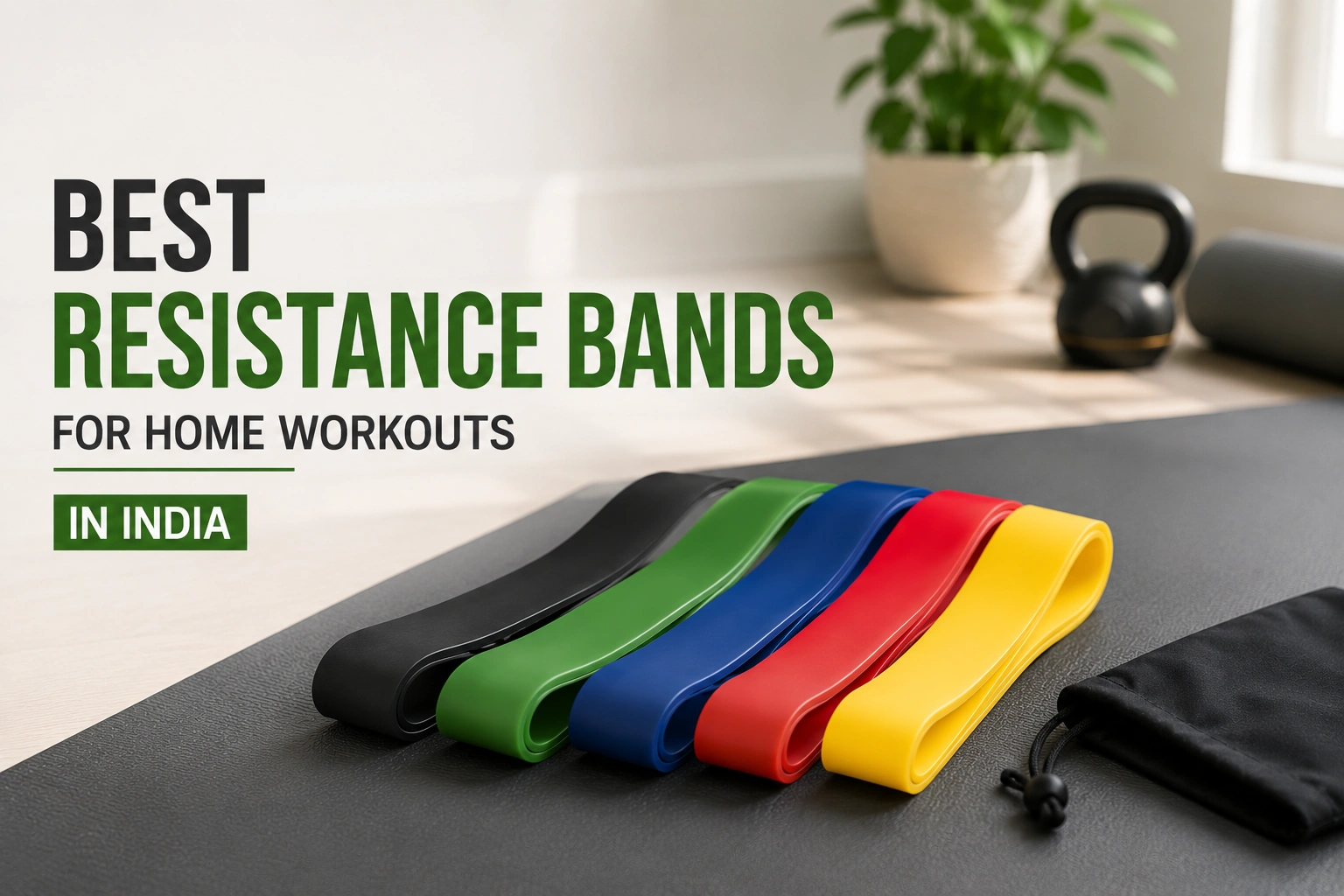
These are small circular bands, usually about 30 to 45 cm in length. You loop them around your thighs, knees, or ankles. They are most commonly used for glute exercises, hip work, and warm-up activation exercises.
- Good for: Glute bridges, squats, lateral walks, clamshells, hip circles
- Material: Usually latex or fabric
- Best for: Lower body training, warm-ups, beginners
Mini bands are often the first type people buy in India because they are cheap, compact, and easy to use.
2. Long Loop Bands or Power Bands
These are large circular bands, roughly 200 cm in circumference. They are the thicker, longer version of mini bands and can handle much heavier resistance.
- Good for: Assisted pull-ups, bent-over rows, chest presses anchored to a door, squats, deadlifts with added resistance
- Material: Usually 100% natural latex in layers
- Resistance range: From very light (around 5 to 10 kg) to very heavy (45 kg and above)
- Best for: Full-body strength training, intermediate to advanced users
These are the most versatile type for home workouts. One long loop band can replace multiple dumbbell exercises if used correctly.
3. Tube Bands with Handles
These look like jump ropes with handles on both ends. You can anchor them to a door, stand on them, or attach them to a fixed point and pull.
- Good for: Bicep curls, shoulder press, chest press, rows, tricep pushdowns
- Material: Latex tube with rubber or foam handles
- Best for: Upper body exercises, people who prefer a grip-friendly design
Many beginners prefer tube bands because holding handles feels more natural than gripping a flat band.
4. Fabric Resistance Bands
These are made from woven fabric instead of rubber latex. They feel softer on the skin and do not roll up or pinch during exercises.
- Good for: Glute work, leg exercises, any exercise where the band sits against bare skin
- Material: Polyester and latex blend
- Best for: Lower body training, people who find latex bands uncomfortable
Fabric bands tend to cost a little more than latex ones but are worth it for comfort during long sessions.
5. Therapy or Flat Bands
These are thin, flat, open-ended bands without a loop or handles. They are the lightest type and are mostly used in physiotherapy and rehabilitation.
- Good for: Shoulder rehab, rotator cuff exercises, gentle stretching, mobility work
- Best for: Injury recovery, very light resistance training, seniors
Top Resistant Bands for Home Workouts You Can Try
1. Long Loop Latex Bands: Best Overall for Home Workouts
If you can only buy one type of resistance band, make it a set of long loop latex bands in multiple resistance levels. These give you the widest range of exercises. You can use them for pull-up assistance, anchor them to a door frame for rows and chest presses, loop them under your feet for curls, or add them to squats for extra resistance.
- What to look for: 100% natural latex, layered construction for durability, at least 3 resistance levels in one set
- Resistance range to buy: One light (around 10 to 15 kg), one medium (around 20 to 30 kg), one heavy (around 40 to 50 kg)
- Price range in India: Rs. 500 to Rs. 2,500 for a set of 3 to 5 bands
Ahaniya lists a resistance band set for men and women that is a practical starting point for home workouts at a reasonable price.
Tip: Always check the band for small cracks or tears before using it. A damaged band can snap during exercise, and that is not pleasant.
2. Fabric Mini Bands: Best for Lower Body and Glute Work
If your main goal is glute training, hip strengthening, or lower body toning, fabric mini bands are excellent. They sit above the knee or around the thighs without rolling up or sliding down, which is a common problem with thin latex mini bands during squats or lateral walks.
- What to look for: Internal grip strips inside the fabric, three resistance levels in one set, machine washable material
- Price range in India: Rs. 400 to Rs. 1,200 for a set of 3
- Good for: Glute bridges, squats, clamshells, lateral steps, donkey kicks
3. Tube Bands with Handles: Best for Upper Body Training
For people who want to mimic dumbbell-style exercises at home, tube bands with handles are the closest thing. You can do bicep curls, shoulder press, chest press with a door anchor, and tricep pushdowns all with one set.
- What to look for: Anti-snap cord inside the tube, strong carabiner clips, padded handles, includes door anchor
- Resistance range: Light to heavy, ideally a stackable set where you can clip multiple bands together
- Price range in India: Rs. 800 to Rs. 2,500 for a full set with handles and door anchor
These are also good for anyone coming back from a shoulder or elbow injury where controlled, low-impact resistance is needed.
4. Light Therapy Bands: Best for Rotator Cuff and Shoulder Rehab
If you have shoulder pain, rotator cuff weakness, or are recovering from an injury, light flat therapy bands are what physiotherapists commonly recommend.
- What to look for: Very light resistance, open-ended flat band (not looped), smooth latex material
- Price range in India: Rs. 200 to Rs. 600
These are not for building muscle. They are for healing and joint strengthening. Use them slowly with controlled movements.
What to Check Before Buying Resistance Bands in India
1. Resistance Level
This is the most important factor. Bands are usually colour-coded by resistance, but colour systems differ between brands. Always check the actual weight or resistance value mentioned in the product description. For beginners, start with light to medium resistance. For intermediate users, a set covering light, medium, and heavy is ideal. Do not buy only one resistance level as you will outgrow it quickly.
2. Material Quality
Look for 100% natural latex in loop and power bands. Natural latex is more durable and maintains its resistance over time better than synthetic alternatives. For fabric bands, check that the material is thick, has internal grip strips, and is described as tear-resistant. Avoid very cheap bands where no material specification is mentioned. These tend to snap or lose their resistance after a few weeks of use.
3. Number of Layers
For long loop or power bands, more latex layers mean better durability and more consistent resistance throughout the movement. Single-layer bands can feel inconsistent and snap more easily under heavy stretching.
4. Set or Individual
Buying a set of 3 to 5 bands in different resistances is almost always better value than buying one band. As your strength grows, you will naturally need heavier resistance, and having multiple levels means you can continue progressing without buying again.
5. Accessories Included
For tube bands with handles, check what is included. A good set should come with a door anchor, two handles, and ideally ankle straps. Without a door anchor, your exercise options become very limited indoors.
6. Length of the Band
This matters more than most people think. If you are tall, a short band will reach full tension too quickly and limit your range of motion. If you are shorter, a very long band may not give enough tension at lighter resistance levels. Most standard long loop bands are around 200 cm in circumference, which works well for most adults.
Resistance Band Exercises You Can Do at Home Without Any Other Equipment
A pair of resistance bands and some floor space is genuinely enough for a complete workout. Here are the exercises grouped by muscle group.
Upper Body Exercises with Resistance Bands
- Bicep curls: Stand on the band, hold both ends, curl upward
- Shoulder press: Stand on the band, press both ends overhead
- Lateral raises: Stand on the band, raise arms out to the sides
- Bent-over rows: Anchor the band under your feet, hinge forward, pull upward
- Chest press: Anchor to a door, press forward with both hands
- Tricep pushdowns: Anchor high on a door, push downward with both hands
Lower Body Exercises with Resistance Bands
- Squats with band: Loop above knees, squat down with knees pushing out against the band
- Glute bridges: Loop above knees, lie on back, push hips upward
- Lateral band walks: Loop above knees, step side to side in a squat position
- Clamshells: Lie on your side, loop above knees, open and close like a clam
- Donkey kicks: On all fours, loop around ankle, kick back and up
Core Exercises with Resistance Bands
- Pallof press: Anchor to a door at chest height, press band straight out and hold
- Woodchops: Anchor high on a door, pull diagonally downward across your body
- Standing crunches: Anchor band above you, hold both ends, crunch downward
Add a cast iron kettlebell alongside your bands for swings and goblet squats, and you have a near-complete fitness equipment for home without spending a lot.
How to Use Resistance Bands Safely at Home
1. Check Before Every Session
Before you start any exercise, hold the band up to the light and look for small nicks, cracks, or thin spots. If you see any damage, replace the band immediately. A snapping resistance band at full stretch is painful and can cause injury.
2. Anchor Points Matter
When using a door anchor, always use the hinge side of the door, not the handle side. Close and lock the door before applying tension. Never anchor a band to anything that can move or tip over.
3. Control the Return
Resistance bands work both ways. The pulling phase and the returning phase both engage your muscles. Do not let the band snap back quickly. Control the movement on the way back for better results and lower injury risk.
4. Store Them Properly
Keep resistance bands away from direct sunlight and heat. UV exposure breaks down latex over time. Store them loosely folded in a drawer or bag, not crumpled up wet. A damp, crumpled band deteriorates much faster.
5. Do Not Overstretch
Every band has a maximum stretch length. Going beyond it is how bands snap. As a general rule, do not stretch a band more than two to two and a half times its resting length during any exercise.
For a fuller picture of how to safely use various types of fitness equipment at home, our beginners guide to using gym equipment covers the key safety habits worth building early.
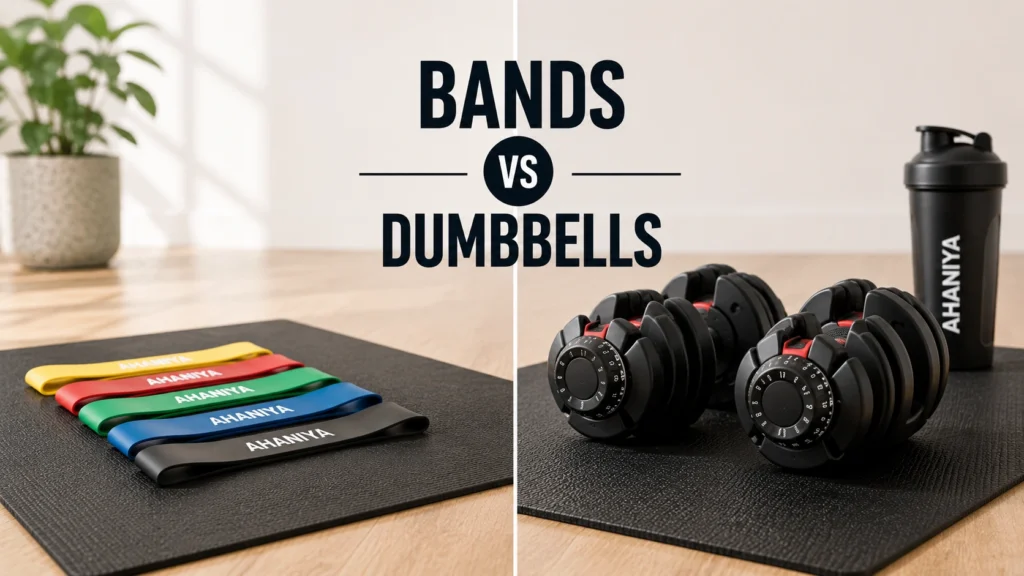
Resistance Bands vs Dumbbells: Which Is Better for Home Workouts
This is one of the most common questions for anyone setting up a home gym. Here is a simple breakdown.
|
Factor
|
Resistance Bands
|
Dumbbells
|
|
Cost
|
Rs. 300 to Rs. 2,500
|
Rs. 1,500 to Rs. 15,000+
|
|
Space needed
|
Almost none
|
Moderate
|
|
Portability
|
Fits in a small bag
|
Heavy and bulky
|
|
Exercise variety
|
Very high
|
Very high
|
|
Muscle building
|
Yes, with right resistance
|
Yes
|
|
Joint stress
|
Lower
|
Moderate
|
|
Durability
|
1 to 3 years
|
Many years
|
|
Best for
|
Beginners, travel, rehab
|
Progressive strength training
|
The honest answer is that both work well. Resistance bands are better when space and budget are limited. Dumbbells give you more precise weight progression as you get stronger. Many people use both together, which gives you the most exercise variety. If you are starting out and can only pick one, resistance bands are the smarter first buy. You can always add convertible adjustable dumbbells later as your strength improves and your budget allows.
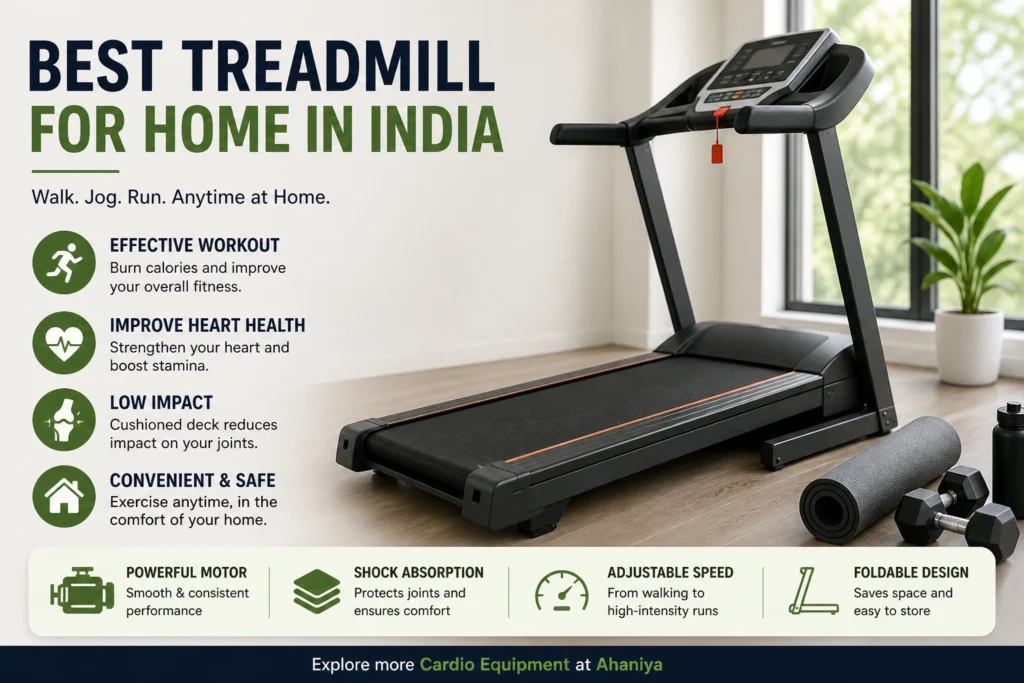
For people who also want cardio at home alongside strength training, our guide on the best treadmill for home use in India covers that side of home fitness well.
Resistance Band Workout for Beginners: A Simple Weekly Plan
If you are new to resistance band training, here is a simple 3-day-a-week plan to get started. Each session takes around 25 to 30 minutes.
Day 1: Upper Body
- Bicep curls - 3 sets of 12 reps
- Shoulder press - 3 sets of 10 reps
- Bent-over rows - 3 sets of 12 reps
- Lateral raises - 3 sets of 12 reps
- Tricep pushdowns - 3 sets of 15 reps
Day 2: Lower Body
- Squats with band - 3 sets of 15 reps
- Glute bridges - 3 sets of 15 reps
- Lateral band walks - 3 sets of 12 steps each side
- Clamshells - 3 sets of 15 reps each side
- Donkey kicks - 3 sets of 12 reps each side
Day 3: Full Body Circuit
- Squats - 15 reps
- Bent-over rows - 12 reps
- Glute bridges - 15 reps
- Shoulder press - 10 reps
- Lateral walks - 12 steps each side
Rest 45 seconds between each exercise. Do the circuit 3 times through.
For more beginner workout ideas using bands, our resistance band workout guide for beginners goes into more detail on technique and progressions.
How Much Should You Spend on Resistance Bands in India
Here is a simple price guide for 2026.
|
Budget
|
What You Get
|
Best For
|
|
Under Rs. 500
|
1 to 2 basic latex loop bands
|
Complete beginners, light use
|
|
Rs. 500 to Rs. 1,500
|
Set of 3 to 5 bands, multiple resistances
|
Most home gym users
|
|
Rs. 1,500 to Rs. 3,000
|
Full tube band set with handles, door anchor, ankle straps
|
Upper body focused training
|
|
Rs. 3,000 and above
|
Premium fabric sets, heavy power bands, branded sets
|
Intermediate to advanced lifters
|
Most people doing general home fitness are very well served in the Rs. 800 to Rs. 1,500 range. That gets you a solid set of multiple resistance levels that covers both upper and lower body training.
At Ahaniya, we focus on helping Indian home gym users find fitness equipment for home that actually fits their space, goals, and budget without wasting money on things they do not need. You can browse our full home gym equipment collection for curated picks across all categories.
Frequently Asked Questions
1. Which resistance band is best for home workout?
A set of long loop latex bands covering light, medium, and heavy resistance is the most versatile option for home workouts. If your focus is mainly lower body and glutes, fabric mini bands are excellent. For upper body exercises, tube bands with handles and a door anchor give you the most exercise options.
2. Are resistance bands good for home workouts?
Yes. Resistance bands are one of the best tools for home workouts. They are affordable, take up almost no space, work for full-body training, and are suitable for all fitness levels from complete beginners to experienced lifters. Research also supports that muscles respond to resistance band training similarly to free weight training when the right resistance and effort level is used.
3. Which brand is best for resistance bands in India?
In India, brands like Boldfit, Prokyde, and Burnlab offer decent resistance bands available through Amazon India. For heavier power bands, Mirafit and Serious Steel are well regarded internationally and sometimes available through import listings. For most Indian home gym users, a well-reviewed set from a reliable Amazon India seller with good ratings and verified reviews works perfectly fine without spending on premium imports.
4. Can resistance bands help with rotator cuff problems?
Yes. Light resistance bands, particularly flat therapy bands, are commonly recommended by physiotherapists for rotator cuff strengthening and rehabilitation. Exercises like external rotations, internal rotations, and band pull-aparts specifically target the small muscles around the shoulder joint. Always start with the lightest resistance possible for rotator cuff work and focus on slow, controlled movement rather than heavy resistance.
5. What are the disadvantages of resistance bands?
The main disadvantages are that resistance is not as precise as fixed weights, bands deteriorate over time and need replacing every one to three years, very heavy resistance levels are harder to achieve compared to barbells or heavy dumbbells, and cheap bands can snap if overstretched or poorly made. These are minor drawbacks compared to the overall value and versatility bands offer for home training.
6. What is the 3-3-3 rule for working out?
The 3-3-3 rule is a simple workout structure that means 3 exercises, 3 sets each, and 3 times per week. It is often recommended for beginners because it is easy to remember, manageable to complete, and consistent enough to produce real results over time. Resistance bands work very well with this format because you can quickly switch between exercises without changing equipment.